The end of a marriage can raise sensitive, complicated issues. While some divorces may start with bitter disputes, even the most amicable separations can become contentious when it’s time to work out the finer details of the split. Divorce cases can become complicated when issues like spousal support or child custody are contested, leading to emotionally charged battles that require careful legal guidance to resolve. It's essential for both parties to have experienced representation to protect their interests and work toward fair outcomes.
For couples looking to avoid the stress of court proceedings, mediation can help couples resolve their divorce matters more amicably without going to court. This process allows both parties to negotiate settlements with the help of a neutral third party, helping them reach an agreement on contentious issues like child custody and division of assets in a less adversarial environment. Mediation can be a valuable tool for couples hoping to maintain a civil relationship post-divorce.
In some cases, arbitration is a useful alternative to litigation, providing a faster resolution for divorce-related disputes. Unlike mediation, where the parties control the outcome, arbitration involves a neutral arbitrator making binding decisions. This can be a quicker and more efficient way to resolve disputes when negotiations stall. Whether through mediation or arbitration, finding a solution outside of court can save time, money, and emotional energy.
Even after a divorce is finalized, circumstances can change, necessitating further legal action. Post-divorce modifications are sometimes necessary when one party’s financial or personal circumstances change after the divorce is finalized, such as job loss or relocation. Additionally, child custody is often one of the most challenging aspects of a divorce, as parents must determine the best arrangement for their children. Changes in the needs of the children or the living situations of the parents may require updates to the custody agreement, ensuring that the child’s best interests remain the priority.
The Shrewsbury divorce attorneys at Bachman & Newman, LLC have a deep understanding of just how complex and contentious divorce cases can be—and we know how to represent and guide our clients at every step to help them:
New Jersey law provides fault and no-fault grounds for divorce:
Divorce involves deciding how certain matters will be resolved to legally end a marriage. These matters generally include (and are not limited to):
How these matters are resolved will largely depend on the couple. That’s because, when exes can agree on all of the terms of their divorce, they can usually get the process completed quickly, with minimal court involvement. When disputes arise—and when these disputes can’t be resolved via mediation or arbitration—the family court will step in to make the final decisions.
No matter how amicable or embittered divorcing parties are with each other, an experienced lawyer can be crucial to getting through divorce as favorably and efficiently as possible.
When it’s time to dissolve a marriage in Monmouth County, it’s time to contact a Shrewsbury divorce lawyer at Bachman & Newman, LLC. Our boutique family law firm is home to talented, trusted divorce attorneys who are known for their dedication and compassion, as well as their expertise and record of success.Strategic Representation for All Types of New Jersey Divorce Cases
The end of a marriage can raise sensitive, complicated issues, from spousal support and the division of property to child custody and child support. That can mean bitter fights from the start of some cases. It can also mean that even the most amicable divorces devolve into battles when it’s time to work out the details.
The Shrewsbury divorce lawyers at Bachman & Newman, LLC have a deep understanding of just how complex and contentious divorce cases can be—and we know how to represent and guide our clients at every step to help them:
Call (732) 431-0150 for exceptional divorce representation throughout Monmouth County, NJ.
From mediation and arbitration to high-net-worth divorce and cases involving allegations of domestic violence, our experienced attorneys are highly skilled at counseling clients through all types of divorce cases.
Divorce is the legal process of deciding how certain matters will be resolved in order to dissolve the marriage. These matters generally include (and are not limited to):
How these matters are resolved will largely depend on the couple. That’s because, when exes can agree on all of the terms of their divorce, they can usually get the process completed quickly, with minimal court involvement. When disputes arise—and when these disputes can’t be resolved via mediation or arbitration—the family court will step in to make the final decisions.
Here’s how the New Jersey divorce process usually works, from start to finish, when disputes arise:
1. A spouse files for divorce.
This is the Complaint for Divorce, and it should be filed in the county of residence. The filer is also referred to as the petitioner or plaintiff in the divorce case.
Once the court accepts the filing, it will notify the petitioner, and (s)he will have 10 days to serve the other spouse with a copy of the complaint.
2.The other spouse has 35 days to file a response.
After being legally served with divorce papers, the recipient (the respondent or defendant) will have the legal opportunity to dispute any point in the initial filing.
An undisputed case could end here, with the respondent not filing any paperwork with the court if (s)he agrees to the terms of the divorce, as explained in the initial complaint.
3. The divorce case will head to pre-trial proceedings.
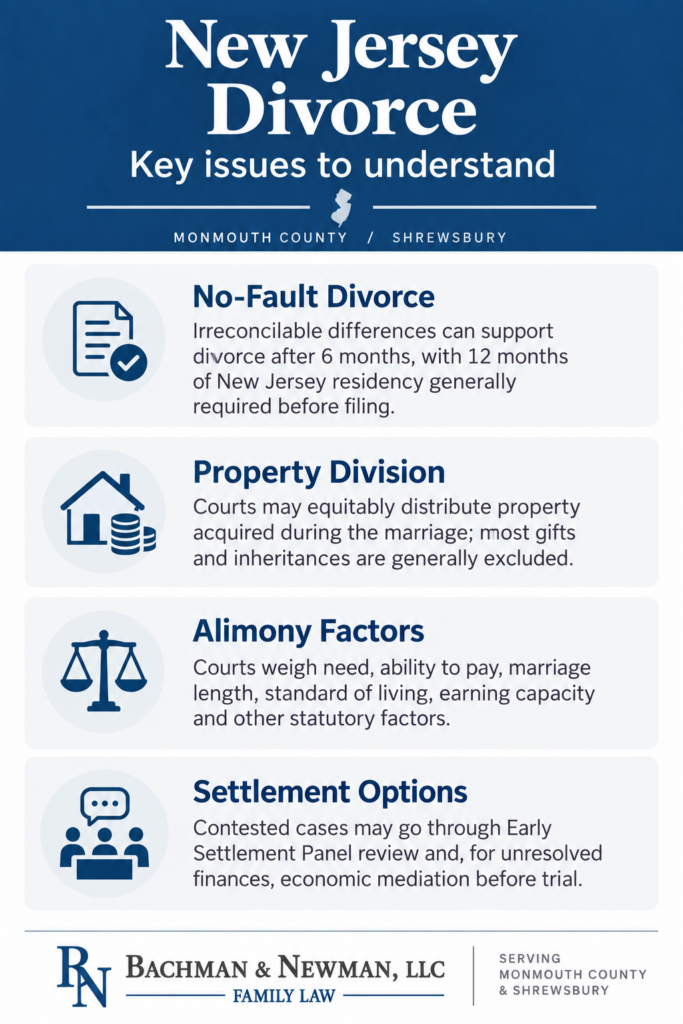
This is done to resolve the case out of court. It includes proceedings with the Early Settlement Panel, economic mediation, and then an intensive settlement conference. It’s mandatory because the courts want to be sure that all other options have been exhausted and unsuccessful before stepping in.
4. The divorce trial occurs.
This is when each spouse will show evidence to support their argument(s) and/or allegation(s). The length of the trial will depend on how complicated and/or extensive the disputes of the divorce are.
5. The judge will issue a final ruling.
After each side is done presenting their case, the judge will deliberate and make a final ruling on all disputed matters. The ruling will be the final divorce decree, which will detail the terms of the divorce and how the disputed issues were settled.
The final divorce decree will then stand until or unless:
Every case is different, and the more complex a case is, the longer it tends to take. On average, it takes about 1.5 years for New Jersey divorce cases to be wrapped up. Most cases, however, are resolved somewhere between 6 and 24 months.
Related: Can You Change Your Divorce Agreement After It’s Finalized?
Shrewsbury, Monmouth County, and New Jersey have a fault and no-fault options for divorce. Here’s a closer look at what that means and how it impacts the grounds for filing for divorce in New Jersey.
In Monmouth County and throughout the state, New Jersey law provides two basic pathways for divorce. The option is chosen impacts the available grounds for divorce.
Contested divorce cases involve disputes, and uncontested divorce cases don’t. So, if a couple agrees on how to divide property, handle support payments, and/or resolve other issues, the case will be uncontested. This can happen when:
If even a single matter is a source of disagreement, the divorce will be a contested case. Officially, a divorce becomes contested when the response to the initial divorce petition has been filed.
When it comes to contested and uncontested divorce cases in New Jersey, it’s essential to know that:
One year. After living in Monmouth County for 12 months, you can file for divorce here. The same holds true for any county in the state of New Jersey, and only the spouse who is filing for divorce has to meet this residency requirement (both spouses do not).
The assets and debts that comprise the marital property will be divided in a way that:
It’s important to understand how the division of property could impact your life after divorce. Bachman & Newman, LLC is ready to help you fight for the fair division of property you deserve.
You will if there’s no way to resolve your case through the many out-of-court options that are available. One of those options, divorce mediation, is usually the best alternative to trial. In fact, with divorce mediation, it can be possible to:
Of course, divorce mediation is not suited for every case or couple. When domestic violence or abuse is an issue—or when there is simply no hope of finding common ground—mediation may not work. In those cases, divorce trial may be a necessary part of the process. And, then, it’ll be more important than ever to have the representation of a divorce lawyer.
When it’s time to dissolve marriage in Monmouth County, it’s time to contact a Shrewsbury divorce lawyer at Bachman & Newman, LLC. Our boutique family law firm is home to talented, trusted attorneys who are known for their dedication and compassion, as well as their expertise and record of success.
Call (732) 431-0150 for essential legal advice about your divorce case.
Backed by more than 100 years of combined family law experience, we have the knowledge, skills, and insights to provide tireless, fierce advocacy for simple to complex divorce cases alike.
Our Shrewsbury divorce attorneys can also:
Reviewed for legal accuracy by Howard A. Bachman on September 18, 2026
What are the key considerations when choosing a divorce attorney?
At Bachman & Newman, LLC, we understand that selecting the right divorce attorney is crucial. It's important to find someone with in-depth knowledge of New Jersey divorce laws and experience in handling cases in Shrewsbury and Monmouth County. Our team of experts ensures that your rights are protected throughout the process, focusing on achieving the best possible outcomes for you and your family.
How does the divorce process work, and what can I expect?
Navigating through a divorce in Monmouth County involves several steps, including filing a petition, responding to it, and, if necessary, going to court. Our approach at Bachman & Newman, LLC is to guide you through each stage, from understanding your options to representing you in court. Our divorce attorneys aim to simplify the process, offering clarity and support every step of the way.
How long does the divorce process usually take in New Jersey?
The timeline varies depending on whether the divorce is contested or uncontested. Uncontested divorces, where both parties agree on all terms, may be finalized within a few months. Contested divorces, especially those involving disputes over custody, property, or support, can take a year or more. Court schedules, discovery, and the complexity of financial issues all affect the timeline. Mediation or arbitration may speed things up if both parties are willing to compromise. Attorneys can help manage the process efficiently and avoid unnecessary delays.
Can I still get a divorce if I cannot locate my spouse?
Yes, it is possible to proceed with divorce even if your spouse cannot be found. In New Jersey, you must demonstrate that you made diligent efforts to locate your spouse, such as checking public records, contacting relatives, or using a process server. If those efforts fail, you may seek court permission to serve notice through alternate means, such as publication in a newspaper. Once proper service is completed, the divorce can move forward. The court may enter a default judgment if your spouse does not respond. Legal counsel ensures compliance with service requirements so the divorce is not later challenged.
What happens if one spouse refuses to sign divorce papers?
A spouse cannot prevent a divorce simply by refusing to sign. If one spouse files, the other will be served with the complaint and given a deadline to respond. Failure to respond allows the court to proceed with a default judgment. Even in contested cases, the court has authority to finalize the divorce after hearings and presentations of evidence. The non-cooperative spouse may lose the ability to influence the terms of the settlement by not participating. An experienced attorney ensures the divorce continues despite refusal or obstruction
In 2026, one common way to submit divorce-related documents without appearing in person is to use the Judiciary Electronic Document Submission system for Family Division filings when it applies to your docket and filing type. You create an account, select the Family division and the appropriate docket category, then upload your documents in the required format so they can be processed during business hours. Even with electronic submission, you still need to follow service rules and meet deadlines, so keep copies of what you filed and confirmation of submission. If you are self-represented, using an established guide can help you understand required forms and avoid missing key items that slow down processing. Electronic submission can be especially helpful for uncontested steps or routine filings, but contested issues may still require conferences, settlement events, or hearings. A divorce attorney can advise whether your filing is eligible for electronic submission, ensure your packet is complete, and help you choose the most efficient path based on your case.
What are the grounds for a divorce in New Jersey, and how does this affect my case?
In New Jersey, divorces can be filed on no-fault grounds, such as irreconcilable differences, or fault-based grounds like adultery or cruelty. Our Shrewsbury divorce attorneys help you understand the implications of each option, advising on the most suitable grounds for your situation, and ensuring your case is handled with the sensitivity and professionalism it deserves.






